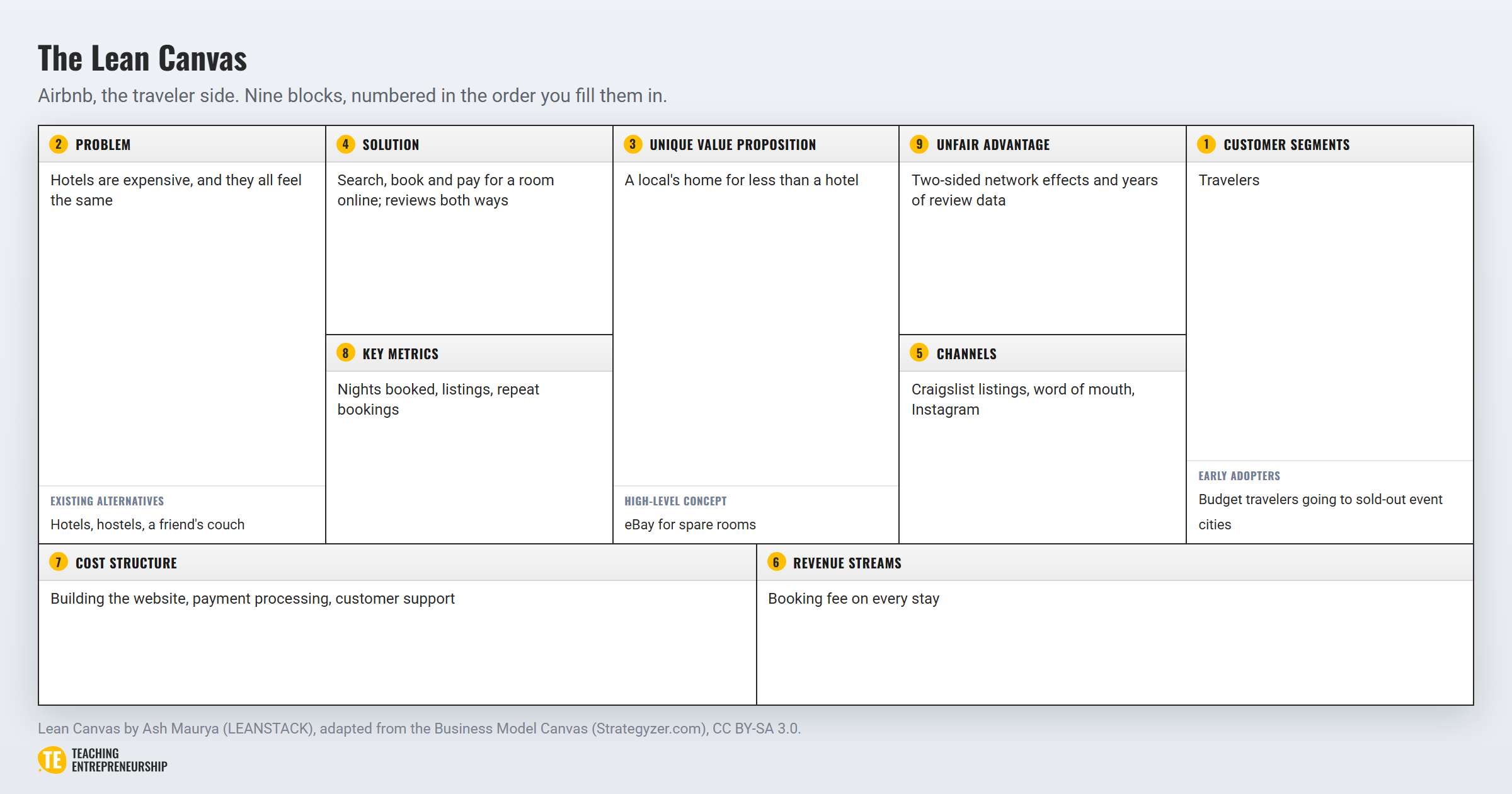
What is the fill-in-the-blank Lean Canvas exercise?
Students get a Lean Canvas for a company they already know with some blocks filled in, and they write the rest. Each round removes a little more scaffolding, until they can build a canvas for their own venture without help.
This is the second of three Lean Canvas exercises. It runs on Dollar Shave Club and then Salesforce, so students see a consumer model and a business-to-business model back to back, and it comes with a free lesson plan and a free editable template.
Use the free Lean Canvas template
Every canvas in this exercise opens pre-filled in our free digital template, so students start from the right starting point with no login and nothing to install.
In Part 1 students learned the nine blocks by placing hypotheses into them. Recognising where a fact belongs is a much easier task than producing one, which is exactly why it comes first.
This exercise is where students start writing hypotheses instead of sorting them.
The scaffolding comes off in stages. Three blocks given, then two, then none.
Round 1: Dollar Shave Club, three blocks given
Play the launch video first. Warn the room about the language. The video is doing double duty on the canvas, and students notice that themselves once they start filling boxes: it is both the Channel and the Unique Value Proposition.
Give students a canvas with Customer Segments, Early Adopters and Problem already filled in, and ask for only two things: the Unique Value Proposition with its High-Level Concept, and the Channels. Think, pair, share, as in Part 1.
Students can open the starting canvas in the tool, or use the printed worksheet from the lesson plan.
The answers
- Unique Value Proposition: a great shave for a few bucks a month.
- High-Level Concept: Netflix for razors.
- Channels: a viral video on YouTube, and an online store.
Student answers do not have to match yours. They have to be specific and testable, which is the standard to hold them to all term.
Round 2: the back half of the same canvas
Same company, same process, this time for the four blocks students find hardest: Revenue Streams, Cost Structure, Key Metrics and Unfair Advantage.
- Revenue Streams: subscription tiers at $1, $6 and $9 a month.
- Cost Structure: blades from the manufacturer, shipping, video production, marketing.
- Key Metrics: subscribers, monthly churn, and the cost to acquire a subscriber.
- Unfair Advantage: almost nothing yet. A funny brand voice and a head start.
Stop on the Unfair Advantage
This is the most valuable two minutes in the exercise. In 2012 Dollar Shave Club had no moat. Gillette could copy the model, and eventually did.
An empty Unfair Advantage box is a true answer for most startups. It is a finding, not a failure.
Students want to write something impressive there, and the habit of writing something impressive instead of something true is the habit this whole course is trying to break. Tell them an honest empty box is worth more than a confident wrong one, because it tells you what to go and build.
The completed Dollar Shave Club canvas is ready to put on screen.
Round 3: Salesforce, only two blocks given
Now a business-to-business model, and the scaffolding drops to two blocks: Customer Segments and Problem. Students fill in everything else.
Give them the context, because most undergraduates were not alive for it. It is 1999. Buying customer relationship management software means paying Siebel millions of dollars and waiting a year for it to be installed.
The answers
- Early Adopters: small sales teams with no IT department.
- Existing Alternatives: Siebel, spreadsheets, sticky notes.
- Unique Value Proposition: CRM as easy to buy as a book on Amazon.
- High-Level Concept: Amazon for business software.
- Solution: web-based CRM, pay per seat, nothing to install.
- Channels: online marketing, sales conferences, and the “No Software” campaign.
- Revenue Streams: a per-seat monthly subscription.
- Cost Structure: cloud infrastructure, marketing and sales, engineering.
- Key Metrics: paid seats, churn, seats per account.
- Unfair Advantage: first mover in web-delivered CRM, and a multi-tenant architecture.
Two things are worth pointing out. The Existing Alternatives box is where the whole business lives: Salesforce did not beat Siebel on features, it beat the spreadsheet on effort. And unlike Dollar Shave Club, this canvas has a real Unfair Advantage, so students get to see both cases in one session.
Students can start from the given canvas or review the completed one.
Round 4: their own venture
Now the scaffolding is gone. Students open a blank canvas in the free tool and fill it in for the venture they are working on.
Set a timer for fifteen minutes and say so out loud. Ash Maurya’s point about the twenty-minute first draft is that a canvas is supposed to be fast and wrong, not slow and wrong. Students who are allowed to take an hour will produce something polished that they then do not want to change.
Ask them to use Share to send you the link. The link carries the whole canvas, so you can read thirty of them without collecting a single file.
Round 5: swap and interrogate
Students swap with a partner. The reviewer asks one question of every box the other person filled in:
Is this a guess or a fact, and how would you know?
Then they switch. That single question is the habit worth building, and it sets up Part 3, where the guesses get ranked by how much damage each one would do if it turned out to be wrong.
Get the Part 2 lesson plan
The lesson plan carries the educator guide, timings, all the answer keys, and the worksheets for every round.
It’s free for any/all entrepreneurship teachers so share it with another instructor you know.
Teaching a full course? The ExEC curriculum builds a whole semester around this way of working, with graded assignments, slides, rubrics and an instructor community. Preview the ExEC curriculum →
The rest of the series
- Part 1: the Lean Canvas template and the matching exercise. The nine blocks, the fill order, and how the Lean Canvas compares with the Business Model Canvas.
- Part 3: find the riskiest assumption. Students rank what to test first, using the Ceres drone case.
FAQ: teaching Lean Canvas examples
What is a good Lean Canvas example for class?
Use a company students already know, so they spend the session reasoning about the model rather than learning the business. Dollar Shave Club works for a consumer subscription, Salesforce for business-to-business software, and Airbnb for a two-sided marketplace. Each one puts a different block under pressure.
Why fill in the blanks instead of starting from a blank canvas?
Producing a hypothesis is much harder than recognising one, and a blank canvas asks students to do the hard thing before they can do the easy one. Removing the scaffolding a round at a time keeps them working just past what they can already do, and it makes the gaps in their thinking visible one block at a time.
How long does this exercise take?
Roughly 50 to 75 minutes for all five rounds with think, pair and share throughout. The two worked companies take about 25 minutes each, and the students’ own canvases take another 25. It splits cleanly across two shorter sessions at the Salesforce round.
What if a student’s Unfair Advantage box is empty?
That is usually the right answer, and it is worth saying so. Most early startups have no moat, and Ash Maurya’s own guidance is to leave the box empty and revisit it. An honest empty box tells a founder what to build toward. A confident wrong one tells them nothing.
Is there a free lesson plan and template?
Yes. The lesson plan above includes the educator guide, all the answer keys and the worksheets, and every canvas in the exercise opens pre-filled in the free Lean Canvas tool, which needs no login and exports a printable PDF.
Want 30+ more engaging exercises?