How do you test a Lean Canvas?
A finished canvas is a wall of guesses, and the useful question is which guess to check first. The riskiest assumption is the one most likely to kill the business, and it is almost never the one students pick.
This is the third of three Lean Canvas exercises. It uses the Ceres drone case from one of Steve Blank’s classes to teach the order that matters: problem risk, then customer risk, then product risk, then market risk. Free lesson plan, rubric and template included.
Use the free Lean Canvas template
The Ceres canvas below opens pre-filled in our free digital template, and students can build their own alongside it with no login.
By now students can place hypotheses on a canvas (Part 1) and write their own (Part 2). Both of those produce a page full of confident statements that nobody has checked.
Teaching students to rank their assumptions is the step that turns a canvas from a description into a plan.
The Ceres case
Play the video, then put the Ceres canvas on screen. Students in one of Steve Blank‘s classes wanted to fly drones over farmland, capture images, and turn them into data that helps farmers fight drought, disease and pests.
Their canvas: farmers lose crops to problems they cannot see in time, they currently walk the fields or buy satellite imagery, and Ceres would show them crop stress a week before it is visible from the ground, sold as a per-acre subscription.
Students can open the Ceres canvas in the tool.
Step 1: What has to be technically true?
Ask students to individually brainstorm the technical assumptions, then pair and share. They will land close to where Steve’s students did:
- Drones can deliver usable images
- Software can extract the right data from those images
- The data can be presented to farmers in a form they can act on
Step 2: What has to be true that is not technical?
Same process. Typically:
- Farmers struggle with disease and drought badly enough to act
- Farmers want to forecast production
- Farmers have a budget for this
- Farmers are willing to pay for data
- Water utilities and fertilizer producers want to partner
Step 3: Which three would you test first?
Ask the question, run think-pair-share, and write the class’s top three on the board before you say anything at all. Then give them the definition: the riskiest assumption is the one most likely to kill the business.
Almost every class picks the technical ones. Let them, and write them up.
Being wrong in public and then finding out why is the entire lesson, and it does not work if you warn them first.
Step 4: The order that actually matters
Now teach the order experienced founders use. Ash Maurya and Alex Osterwalder built different canvases and agree on this completely:
- Problem risk. Do they actually have this problem, and does it hurt enough to pay to fix?
- Customer risk. Can you find and reach the early adopters at all?
- Product risk. Can you build something that solves it?
- Market risk. Do the numbers add up into a business?
Feasibility questions, the “can we build it” ones, feel riskiest because they are the ones we know how to work on. Desirability questions are the ones that actually kill companies.
A problem without a solution is a matter of time. A solution without a problem is a waste of time.
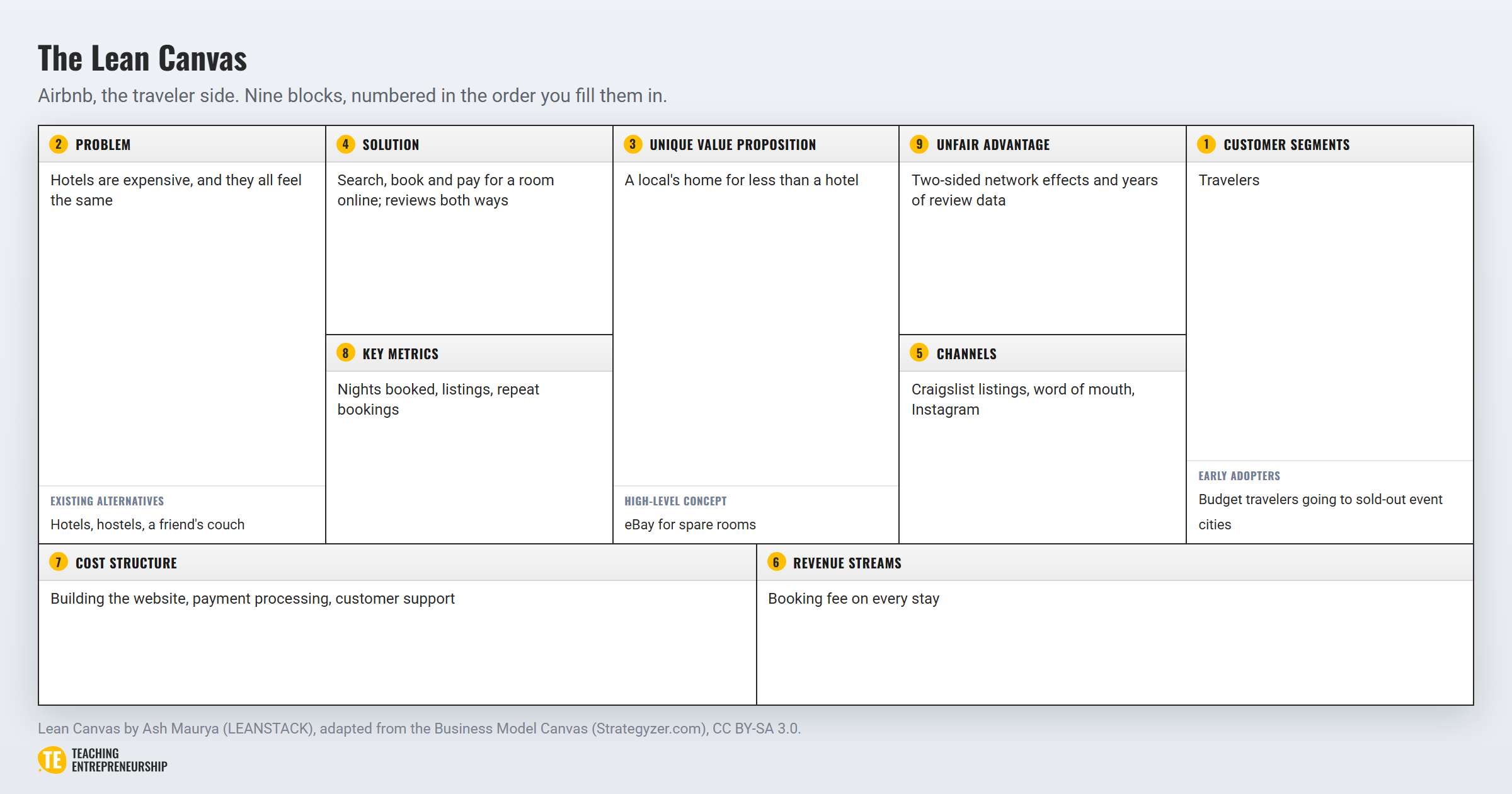
On the Lean Canvas this maps to geography. The risk lives in the left-hand column, which is precisely why Maurya put Problem where Osterwalder had Key Partners. Students who have seen the two canvases side by side get that connection immediately.
Step 5: What actually happened to Ceres
Tell them the ending. The team went and interviewed farmers, and the farmers asked a question nobody in the room had thought of:
Why would you build drones to take pictures when we already fly planes over these fields to spray them?
They could hang a camera on the plane that was already flying. Drones left the Solution box entirely, and the business got cheaper for the company and for its customers.
Make the counterfactual explicit, because that is where the lesson lands. Had they built the drones first and talked to farmers second, they would have spent millions of dollars building technology the business did not need. Instead the team went on to raise significant funding.
Step 6: Homework on their own venture
Three things:
- Fill in their Lean Canvas in the free tool and share the link with you.
- Name and rank their three riskiest assumptions, and say why each is riskier than the one below it.
- Talk to three people who match what they wrote in the Early Adopters box, and report what they heard rather than what they hoped.
That third one is Maurya’s Problem Interview, and it is where a course goes next: teaching customer interviewing and problem validation.
How to grade the assignment
The rubric grades a canvas on whether it can be tested, not on whether it sounds impressive. Four criteria, equally weighted:
- Early adopters are specific and countable. Named with a proxy you could use to find them, not a demographic.
- Problems are observable behaviour. Stated as something the customer already does about it today.
- Each solution feature maps to one problem. Three features, three problems, matched.
- The three riskiest assumptions are named and ranked. Desirability ahead of feasibility, each with a test the student could run this week.
The full version, with wording for all four levels of each criterion, is in the lesson plan below. Hand it to students in advance so they know what a good canvas looks like.
Get the Part 3 lesson plan and rubric
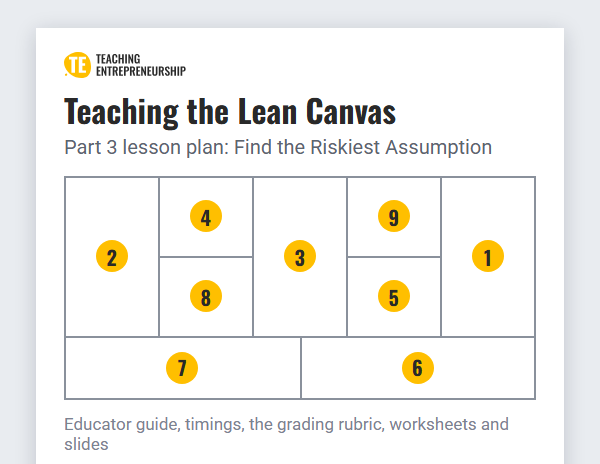
The lesson plan carries the educator guide, the timings, the full assumption lists, the Ceres worksheet, and the four-by-four grading rubric.
It’s free for any/all entrepreneurship teachers so share it with another instructor you know.
Teaching a full course? The ExEC curriculum builds a whole semester around this way of working, with graded assignments, slides, rubrics and an instructor community. Preview the ExEC curriculum →
The rest of the series
- Part 1: the Lean Canvas template and the matching exercise. The nine blocks, the fill order, and how the Lean Canvas compares with the Business Model Canvas.
- Part 2: fill-in-the-blank Lean Canvases. Dollar Shave Club and Salesforce, with the scaffolding removed a round at a time.
If your course also uses the Business Model Canvas, the prioritization exercise in that series teaches the same skill on the other canvas, using the same case.
FAQ: testing a Lean Canvas
What is the riskiest assumption on a Lean Canvas?
The riskiest assumption is the one most likely to kill the business if it turns out to be wrong. For most early ventures it is a desirability assumption, sitting in the Problem or Customer Segments block: that the problem is real, that it hurts enough to pay to fix, and that you can find the people who have it.
Why test desirability before feasibility?
Because a problem without a solution is a matter of time, and a solution without a problem is a waste of time. If people genuinely have the problem, there are many ways to solve it. If nobody has it, the most impressive technology in the world is worth nothing, and every hour spent building it is gone.
How do students test an assumption?
The cheapest test is almost always a conversation with someone in the Early Adopters box, asking what they do today rather than whether they like the idea. After that come small experiments: a landing page, a concierge version done by hand, or a pre-order. The point is to spend hours rather than months finding out.
How long does this exercise take?
About 45 to 60 minutes. The two brainstorming steps run 8 minutes each with think, pair and share, the ranking discussion takes about 10, and the risk-order teaching plus the Ceres ending takes 15. It fits a 75-minute session with time for the homework brief.
Is there a free lesson plan, rubric and template?
Yes. The lesson plan above includes the educator guide, the full assumption lists, the Ceres worksheet and a four-by-four grading rubric, and the canvas itself opens in the free Lean Canvas tool, which needs no login and exports a printable PDF.
Want 30+ more engaging exercises?