What is the Lean Canvas?
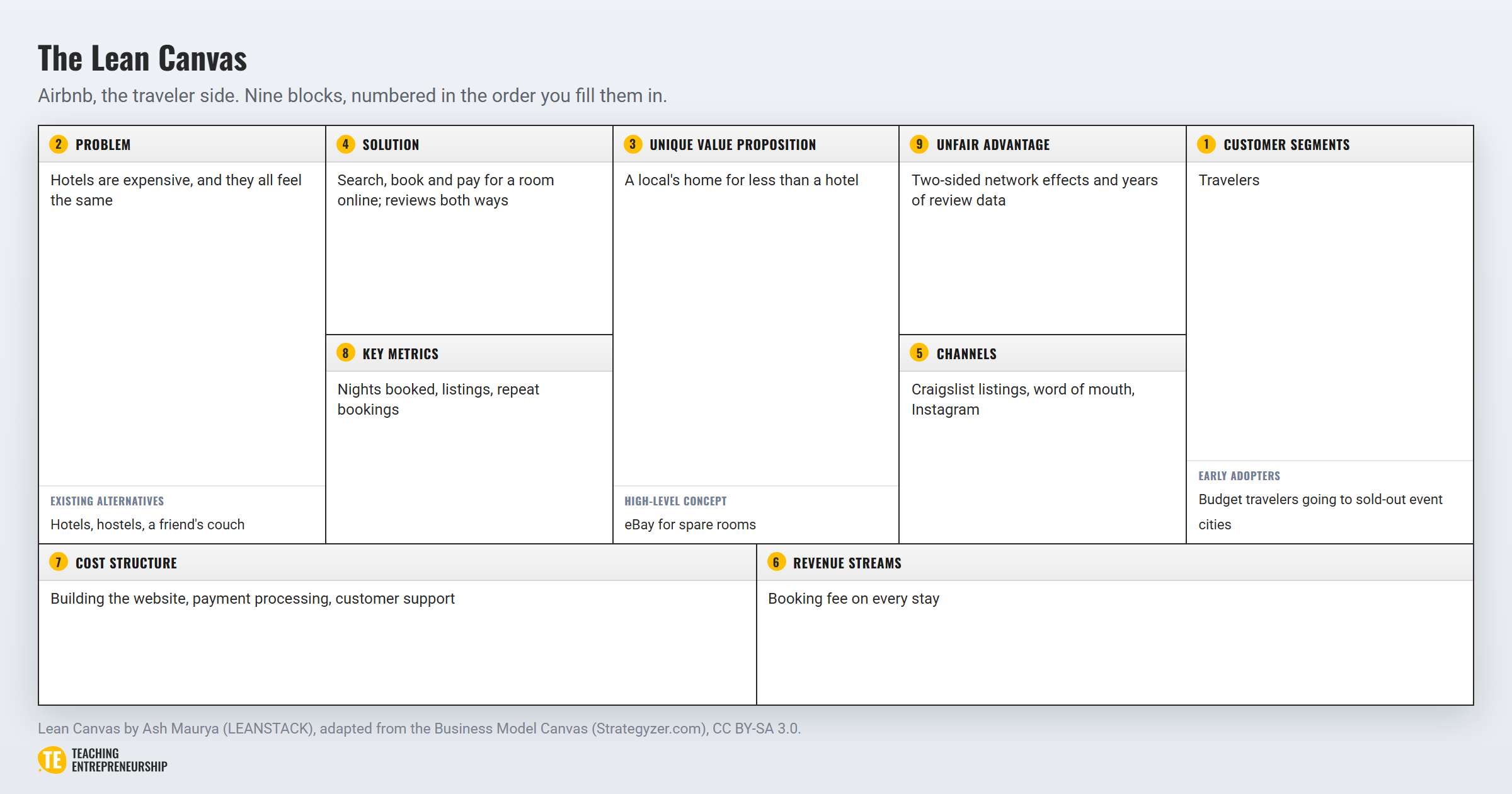
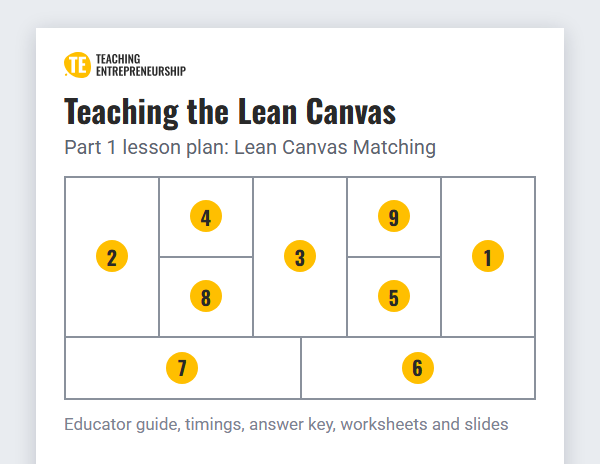
The Lean Canvas is a one-page business plan, created by Ash Maurya in 2010 as an adaptation of Alex Osterwalder’s Business Model Canvas. It maps nine blocks: Problem, Customer Segments, Unique Value Proposition, Solution, Channels, Revenue Streams, Cost Structure, Key Metrics, and Unfair Advantage.
Maurya built it for founders who have not found their customer yet, so it asks what problem you are solving and who feels it most. This guide gives you a free editable template, the nine blocks explained with a worked example, an honest comparison with the Business Model Canvas, and three classroom exercises with lesson plans you can run this week.
Use the free Lean Canvas template
Fill in the canvas online with our free digital template, share a link that carries the whole canvas, or download it as a printable PDF. No student login, and nothing to install.
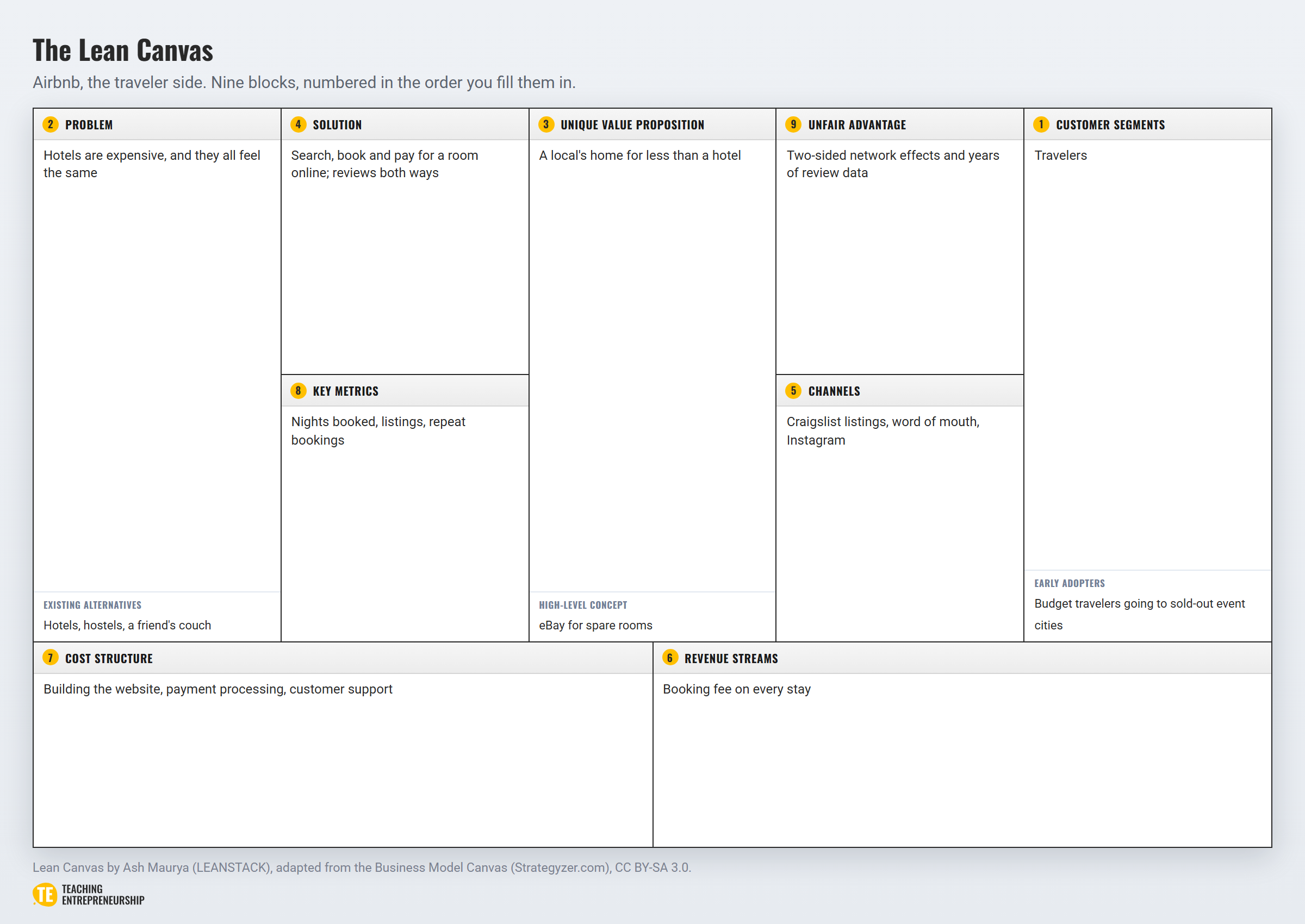
Most students meet the Business Model Canvas first, and then someone hands them a Lean Canvas and says it is the startup version. That is true, and it is not very useful in a classroom, because it does not tell you what changes about the conversation.
What changes is that the Lean Canvas will not let a student describe a business without naming the problem it solves and the specific person who has it.
This guide covers the nine blocks, the order to fill them in, when to teach the Lean Canvas instead of the Business Model Canvas, and three exercises with free lesson plans.
The 9 blocks of the Lean Canvas, explained
Each block answers one question. The examples below are Airbnb, on the traveler side of the marketplace, which is the company we use for the first classroom exercise.
1. Customer Segments
Who are you creating this for, and who feels the problem most? Maurya separates customers who pay from users who do not. A smaller field underneath asks for Early Adopters: the specific people who will try you first. “Travelers” is the segment. “Budget travelers going to sold-out event cities” is an early adopter you could actually go and find.
2. Problem
The top one to three problems your early adopters have. Hotels are expensive, and they all feel the same. The smaller field underneath is Existing Alternatives, which Maurya calls the most important block on the canvas, because customers judge anything new against what they already do. For Airbnb in 2008 that was hotels, hostels, and a friend’s couch.
3. Unique Value Proposition
A single, clear, compelling sentence that says why you are different and worth paying attention to. A local’s home for less than a hotel. Underneath it sits the High-Level Concept, an X-for-Y analogy that makes the idea travel: eBay for spare rooms.
4. Solution
The top three features, one per problem. This box is deliberately small. Maurya made it that way because founders are more in love with their solution than with anything else on the page, and a small box is a constraint on that.
5. Channels
Your path to customers, free and paid. Early on that means the path to a handful of early adopters, not a scalable marketing plan. Airbnb started on Craigslist.
6. Revenue Streams
The revenue model, price, and lifetime value. Maurya’s argument for pricing early is that getting paid is the first real form of validation, and that price is part of the product rather than a decision to make later.
7. Cost Structure
What it costs to build the product and run the business, over the next three to six months rather than five years.
8. Key Metrics
The three to five numbers that tell you the model is working. Outcomes rather than outputs, and leading indicators rather than trailing ones.
9. Unfair Advantage
Something that cannot be easily copied or bought. This is the hardest block on the canvas, and Maurya says it is normal to leave it empty at the start and come back to it. In a classroom, an honest empty box teaches more than a confident wrong one.
A note on the count. LEANSTACK’s current page describes twelve blocks rather than nine, because it counts Existing Alternatives, High-Level Concept and Early Adopters as blocks in their own right. It is the same canvas. The printed template has always had nine boxes with three fields inside them.
What order should students fill out the Lean Canvas?
Ash Maurya has answered this two different ways, and both answers are useful in a classroom.
In Running Lean and in his own step-by-step guide, he numbers the boxes and starts with the customer: Customer Segments and Problem together, then Unique Value Proposition, Solution, Channels, Revenue Streams and Cost Structure, then Key Metrics, and Unfair Advantage last. The logic is that you start with what you are most confident about and move toward what you are guessing, and that you cannot define a problem without naming who has it.
More recently he has written that there is no right fill order, because good ideas do not always start with a customer, and the apparently random layout is a gift: it lets people follow their own thinking.
For a class of thirty, use the numbered order for the first draft. Then use his second answer as the debrief.
Ask students which box they would have filled in first if nobody had told them. Where they start is a decent read on what they are biased toward. Solution-first thinkers reach for the Solution box, and they are the ones most likely to build something nobody asked for.
Lean Canvas vs Business Model Canvas: which should you teach?
Maurya kept five blocks from the Business Model Canvas and replaced four. The four he replaced are the ones a running business needs and a startup cannot answer yet.
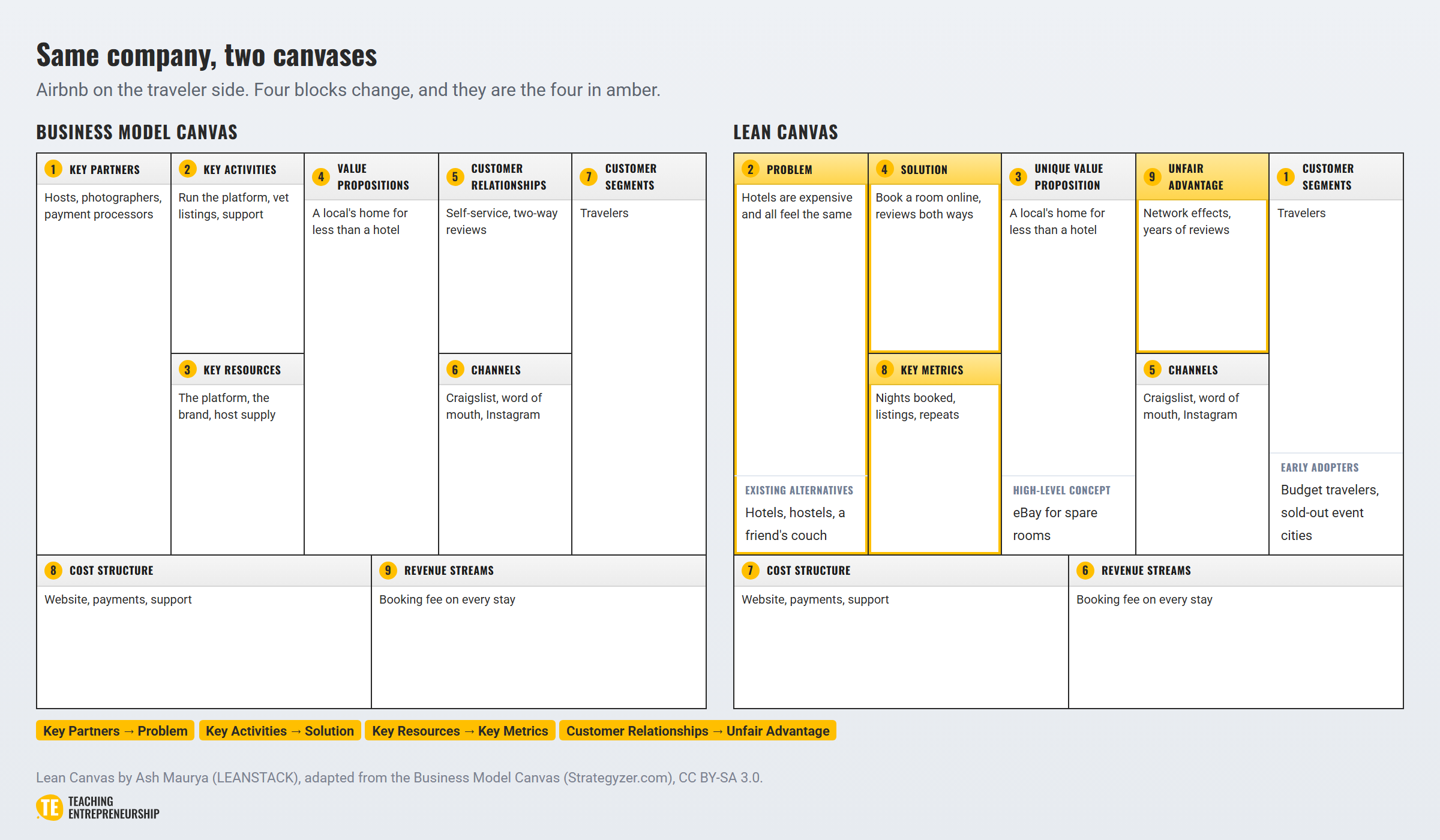
| Business Model Canvas | Lean Canvas | Maurya’s reason for the swap |
|---|---|---|
| Key Partners | Problem | Chasing partnerships as an unknown startup is usually waste. Most startups fail because they build the wrong product, which is a problem-understanding failure. |
| Key Activities | Solution | Activities are what you do once you know the solution. The small Solution box is a deliberate guard against falling in love with the first idea. |
| Key Resources | Key Metrics | Listing “developers” as a resource does not register as risk. Measuring the wrong thing does, and leads to premature optimization. |
| Customer Relationships | Unfair Advantage | Early on the relationship should be direct, through interviews. What matters instead is whether anything stops a copycat once you work. |
What each canvas is good at, and what it misses
| Strengths | Weaknesses | |
|---|---|---|
| Business Model Canvas | Describes a whole operating business, including who you depend on. Handles multi-sided marketplaces and platforms well. It is the shared language of most textbooks, accelerators and investors, so students meet it again after your course. | No box for the problem, so a student can fill in all nine and never say why anyone would buy. Weak for a pre-product idea, and slower to iterate on. Needs the Value Proposition Canvas alongside it to cover customer needs. |
| Lean Canvas | Forces the problem, the early adopters, the numbers and the moat onto the page. Fast to fill and fast to change, which suits a semester where students are still discovering. Points straight at what to test next. | Drops partners, activities and resources, so it describes a running business poorly. Assumes a startup: a student mapping an existing company or a nonprofit will find boxes that do not fit. Unfair Advantage is often empty and can invite bragging. |
So which one belongs in your course?
Both, in this order. Teach the Business Model Canvas when students need the anatomy of a business, because it names every part and it is what they will see everywhere else. Teach the Lean Canvas the moment students have their own idea, because it turns a description into a list of things to go and check.
If you only have room for one, let the course decide. An introduction to entrepreneurship survey course is better served by the Business Model Canvas. A venture practicum, an accelerator, or any course where students leave with something they intend to build is better served by the Lean Canvas.
How to use the Lean Canvas in a college entrepreneurship course
Introduce it once students have a rough idea but before they commit to building anything, and treat it as a list of guesses rather than a worksheet to complete. Most instructors spend one session on the matching exercise below, then come back to the canvas through the term as evidence arrives and blocks change.
It pairs naturally with a syllabus that sequences problem discovery, validation and pitching, and with a design thinking exercise earlier in the term to ground students in real customer needs.
Every exercise below runs on the free tool, so students can work on a phone or a laptop, share a link with you that carries their whole canvas, and never make an account.
Exercise #1: Lean Canvas Matching
Students learn the nine blocks by placing hypotheses into them, not by hearing them defined. This is the same structure Alex Osterwalder uses to introduce the Business Model Canvas, and it works for the same reason: recognising where a fact belongs is a harder and more useful task than remembering a label.
Prepping Before Class
Ask students to read Ash Maurya’s own explainer beforehand, about ten minutes, and to arrive able to name the nine blocks. Print the worksheets from the lesson plan below, or send students the blank Airbnb canvas, which opens in the free tool with nothing to install.
Step 1: Think
Give each student the Airbnb (travelers) worksheet with twelve hypotheses listed below the canvas. Each one goes in exactly one box, and three of them belong in the smaller fields. Give them the first placement so they see how it works: “Travelers” goes in Customer Segments.
Step 2: Pair
Students pair with someone not sitting next to them and compare, talking through anything they disagree on. This is the step instructors skip when time is short, and it is the one that makes the class discussion work.
Step 3: Share
Go box by box in fill order, asking a different pair each time, and have the room vote before you reveal each answer. Two arguments come up almost every time. Students want to put the app in Unfair Advantage, and they want to put revenue in Key Metrics. Both are worth having out loud.
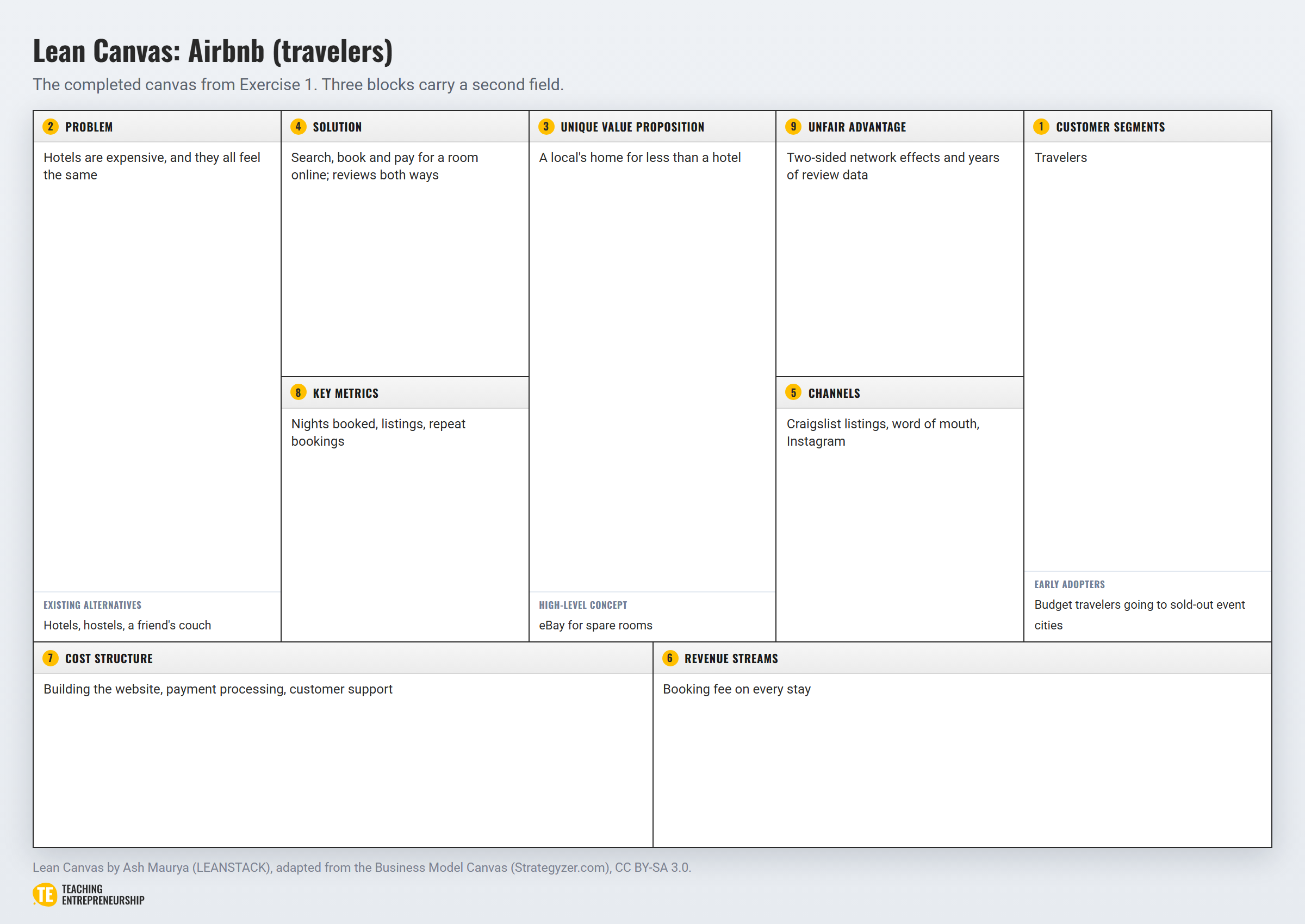
The answer key. You can also open it in the tool to put on screen.
Step 4: Put it next to a Business Model Canvas
Show the same side of the same company on both canvases and ask three questions. Which four boxes changed? What did the Lean Canvas make you say that the Business Model Canvas did not? And what did you lose?
That last one has a real answer: Airbnb’s photographers and its payment processors are Key Partners on a Business Model Canvas, and they appear nowhere on a Lean Canvas. Students arguing about that are having the pros-and-cons discussion themselves, which beats hearing it from you.
How to debrief the Lean Canvas exercise
Three questions close the session:
- Which box was hardest to agree on, and why?
- Which box would you have filled in first if nobody told you the order? Where you start says something about what you assume matters.
- If this were your company, which single box would you go and test first?
That last question is the whole of Exercise 3, and it is the reason the canvas exists.
Five mistakes students make on a Lean Canvas
- Early adopters you cannot count. “Music lovers” is not a group you can go and find on a Tuesday. Push for a countable proxy: where they gather, what they already pay for.
- Problems too vague to interview about. “The high cost of workplace injuries” is a category. Ask who noticed it and what they did about it.
- A Solution box that reads like a brochure. Three features, one per problem. The box is small on purpose.
- “Social media” as a channel. Name the platform, and ideally the specific place inside it where the early adopters already are.
- An Unfair Advantage that is a brag. “Our passionate team” can be hired away. An empty box is more honest, and it is a better prompt for what to build toward.
How to grade a student Lean Canvas
Grade a canvas on whether it can be tested, not on whether it sounds impressive. Four criteria, equally weighted:
- Early adopters are specific and countable. Named with a proxy you could use to find them.
- Problems are observable behaviour. Stated as something the customer already does about it today, which makes Existing Alternatives write itself.
- Each solution feature maps to one problem. Three features, three problems, matched.
- The three riskiest assumptions are named and ranked. Desirability ahead of feasibility, each with a test the student could run this week.
The full four-by-four rubric, with wording for every level, is inside the Part 3 lesson plan below.
Get the Lean Canvas lesson plan
The Part 1 lesson plan has the educator guide, timings, the prompts and the answer key for the matching exercise above. The printable worksheet packet and the slide deck are linked inside it, and every worksheet also opens pre-filled in the free tool. Parts 2 and 3 each have their own lesson plan on their own page: Part 2, fill in the blanks and Part 3, find the riskiest assumption.
It’s free for any/all entrepreneurship teachers so share it with another instructor you know.
Teaching a full course? The ExEC curriculum builds a whole semester around this way of working, with graded assignments, slides, rubrics and an instructor community. Preview the ExEC curriculum →
Continue the series: Parts 2 and 3
- Part 2: Lean Canvas examples, fill in the blanks. Students write their own hypotheses with the scaffolding removed one round at a time, using Dollar Shave Club and Salesforce.
- Part 3: Find the riskiest assumption. Students rank what to test first, using the Ceres drone case from Steve Blank’s class.
What comes after the canvas
A finished canvas is a list of guesses, and the next move is to check the riskiest one. That means talking to the people in the Early Adopters box, which is where teaching customer interviewing and problem validation pick up. If your class also works with the Business Model Canvas, the prioritization exercise from that series teaches the same skill on the other canvas.
FAQ: the Lean Canvas in the classroom
What is a Lean Canvas template?
A Lean Canvas template is a one-page grid of nine blocks that captures a business model: Problem, Customer Segments, Unique Value Proposition, Solution, Channels, Revenue Streams, Cost Structure, Key Metrics and Unfair Advantage. Ash Maurya created it in 2010 by adapting the Business Model Canvas for early-stage startups. A free editable and printable template is available above, with no sign-in.
What is the difference between the Lean Canvas and the Business Model Canvas?
The Lean Canvas keeps five blocks from the Business Model Canvas and replaces four. Key Partners becomes Problem, Key Activities becomes Solution, Key Resources becomes Key Metrics, and Customer Relationships becomes Unfair Advantage. The effect is that the Lean Canvas asks what problem you solve and who feels it, while the Business Model Canvas describes how an operating business is put together.
In what order should you fill out a Lean Canvas?
Maurya’s numbered order starts with Customer Segments and Problem together, then Unique Value Proposition, Solution, Channels, Revenue Streams, Cost Structure, Key Metrics, and Unfair Advantage last. He has also written that there is no single right order, and that starting where you are most confident is fine. For a class, use the numbered order for the first draft, then ask students where they would have started on their own.
How long does a Lean Canvas take?
Maurya’s guidance is that a first draft should take under twenty minutes, because the point is to capture what you are assuming rather than to be right. As a classroom exercise with think, pair and share built in, the matching exercise above runs 45 to 60 minutes in a 75-minute session.
Is the Lean Canvas free to use?
Yes. The Lean Canvas is adapted from the Business Model Canvas and is licensed under Creative Commons Attribution-Share Alike 3.0, so you may use it, adapt it and share it as long as you credit the source and license your version on the same terms. Credit Ash Maurya and LEANSTACK, and note that it is adapted from the Business Model Canvas by Strategyzer.
Should I teach the Lean Canvas or the Business Model Canvas?
Teach both if you have room, the Business Model Canvas first for the anatomy of a business and the Lean Canvas when students have their own idea to test. If you only have room for one, an introductory survey course is better served by the Business Model Canvas, and a venture practicum where students build something is better served by the Lean Canvas.
Is there a printable Lean Canvas PDF?
Yes. The free tool exports a printable PDF, either blank as a classroom handout or filled in with a student’s work. The exported PDF carries the required Creative Commons attribution, and a link back to the editable version.
Want 30+ more engaging exercises?